

New trigger for collective redundancies - what options is the government considering?

The government has launched a new consultation to consider what the additional threshold should be for triggering collective consultation obligations where an employer anticipates making a number of its staff redundant across various sites.
10.03.2026
Current position
Employers must go through a prescribed period of collective consultation once they propose to make 20 or more employees redundant at one establishment within a period of 90 days. Large scale redundancies spead across multiple sites, won't trigger the duty unless at least 20 employees are being made redundant at a site. That means that the duty can arise in some sites, but not others.
Employment Rights Act 2025
The Employment Rights Act 2025 seeks to address this disparity by introducing a new trigger.
The current trigger will remain. But, in addition, employers will have to undertake collective redundancy consultation whenever they propose to make a threshold number of redundancies across their entire organisation.
The government is seeking views on the level and methods by which the new organisation-wide threshold for triggering collective redundancy obligations might be set and is considering two options:
using a single fixed number in the range of 250 to 1,000; or
tiering this new obligation based on number of employees.
Option one: single fixed number
The government believes that using a fixed number is the easiest way for both employers and trade unions/employees to understand when collective consultation is required.
It has suggested a range of 250-1,000 will avoid placing disproportionate regulatory burdens on small and medium businesses (a risk if set lower than 250), whilst ensuring that employees still benefit from collective consultations (a risk if set higher than 1,000).
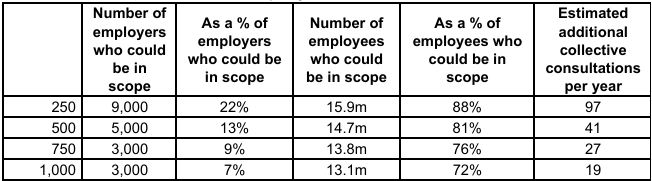
The government wants to know which fixed number to apply within that range. It has provided a table to show how many employers are likely to be in scope if the figure is set at 250, 500, 750 or 1000 employees.
Option two: tiered based on number of employees
The government is asking for views on three proposals under this head, the most significant of which is:
1. Different fixed number thresholds depending on the size of the employer
Under this model, employers would need to collectively consult their workforce where it meets the following thresholds:
250 redundancies for organisations with 0-2,499 employees,
500 redundancies for those with 2,500-9,999 employees; and
750 redundancies for those with 10,000 or more employees.
Employers will have to calculate how many staff it employees on a snapshot date - 5 April each year to make this as simple as possible to administer.
This approach would permit the largest employers to make many more redundancies without being required to undertake collective consultation, and so the government's view is that this option may not provide adequate protection to employees.
The other options being considered are:
2. Percentage of the workforce
Under this method, collective consultation would be triggered when an employer proposes to make a certain percentage of its total workforce redundant.
3. A hybrid combining fixed numbers and percentage thresholds
This option is the most complicated. It involves using both fixed numbers and a percentage threshold.
Under this system, if an employer employs fewer than a certain number of employees, it would have to collectively consult if it planned to make a set percentage of them redundant.
Large employers would have to collectively consult if they proposed a certain number of redundancies organisation-wide.
The government are not keen on either 2 or 3.
When will the additional threshold come into force?
The additional trigger will be added to TULRCA via new regulations and is expected to come into force in 2027.
How to respond
You can respond here. The consultation closes on Thursday 21 May.
Our newsletters
We publish monthly employment and education newsletters. If you'd like to be added to the mailing list, please let me know.
Key Contacts
Related Articles
 Expert CommentThe government has confirmed it's going to reform non-compete clauses.Over the last few years, governments of various colours have carried out successive consultations and policy reviews on whether non-compete clauses stifle competition, innovation and labour mobility, without ever quite pulling the trigger on reform.
 Expert CommentDo short notice periods undermine the enforceability of restrictive covenants?That was one of the issues the court had to decide in a recent case.
 Expert CommentEmployment Rights Act: updated timeline for schools and collegesThe Employment Rights Act 2025 ('the ERA 2025') is coming into force in stages.


